Yesterday I participated in a conference at Luxembourg University's Faculty of Law entitled "Tax Cooperation vs. Tax Competition: Cross-Atlantic Perspectives."
First Tracy Kaye presented a talk on countries' cooperation (or not) with respect to information exchange. The U.S., despite its own efforts pursuant to FATCA, has been notably uncooperative itself with respect to implementing and following common reporting standards (CRS), and these days the odds of FATCA repeal would appear to be higher than those for expanded cooperation. While Tracy considers repeal unlikely given the huge efforts that went into implementing FATCA and its apparent success in boosting compliance and revenues, the people who will make the call may not care much about any of that. But said people are probably more likely to be in the Congressional leadership than the White House or Treasury given knowledge and staffing levels in the Executive Branch.
I was the second presenter, and I discussed the EU state aid cases from a mainly U.S. perspective that was drawn to a degree (but not rigidly or slavishly) from my paper on the subject. I'll post short slides on this after my return to the U.S. in about a week,
The third presenter was Yariv Brauner, who discussed formulary apportionment, as a global option to replace transfer pricing, in light of the U.S. states' experience. They started with the three-factor formula (sales, payroll, property) but have been moving towards sales-only or mostly sales. Yariv is skeptical that countries will find it in their interests to cooperate very fully, but there is an argument that sales-based apportionment might turn out to be decently incentive-compatible.
Then it was off to Finland (in a resort just outside Helsinki) where I will offer a talk tomorrow entitled "The Rise and Fall of the Destination-Based Cash Flow Tax: What Was That All About?"
Wednesday, May 31, 2017


Saturday, May 27, 2017
Sergeant Pepper reissue
I'm obviously deep in the tank for that Liverpool group, whose music spoke to me so deeply as an adolescent (at which time they had recently broken up) and has continued to do so afterwards. But Sergeant Pepper is the one album by them that I sometimes feel is buried or outweighed by the hype. Part of the problem, of course, is its instant canonization as The Greatest Album of All Time, which as, Rob Sheffield sagely remarks in his new book, preceded their even composing most of the songs.
I perforce accepted this canonization at the time (going back to the early 1970s - in real time I heard a number of their great late-60s singles but not really the albums until around 1970). But even now it's hard to get past the hype, and to avoid holding it against the album.
On balance, I think the Sergeant Pepper album is great at both ends but weak in the middle. And the concept is a bit too McCartney-weighted, rather than being more properly balanced. I do happen to like John's song "Good Morning, Good Morning" more than many do. To me it evokes ennui and desperation, rather than just being a throwaway.
Perhaps the album would have come out more consistently strong if they had held back Penny Lane and Strawberry Fields for it (although those two songs made a perfect and truly great single - possibly their best unless you prefer Hey Jude/Revolution). But I prefer to the Sergeant Pepper album, at a minimum, Rubber Soul, Revolver, and the White Album (despite or perhaps because of its imperfections). Also Abbey Road if one overlooks a couple of its weakest songs. One could also very reasonably prefer, say, A Hard Day's Night, although that raises commensurability issues. And even the lightly regarded Help! has an astoundingly strong Side 1.
So that brings us to the reissue, which if you go whole hog is 6 disks and more than $100. But I've decided that getting to listen to the remix, plus the outtakes from CD-2, on Spotify is good enough for me. I'll live without the outtakes on CDs 3 and 4 (insofar as I don't already have them), given the price.
One problem with Sergeant Pepper outtakes is that they tend to sound a lot like the finished album tracks, minus all the touches that were added in production. Outtakes from other albums, when they were doing more live playing together and sometimes took detours before finding a given song's final form, tend to be more interesting. The one exception here, Strawberry Fields' with its fascinating evolution, has already been thoroughly covered elsewhere, especially if you don't limit yourself to the official releases from Anthology 2.
Next year will be the 50th anniversary of the White Album, and that could REALLY use an expanded reissue. Despite some coverage on Anthology 3, there is lots more. For example, the complete Esher Demos (Beatles Unplugged in George's house right after they returned from India). This has been bootlegged but ought to be released officially. Revolution Take 20 (the "take your knickers off" take), which shows the join between Revolution 1 and Revolution 9. The full version of "Can you take me back where I came from?," although they picked the best part of it for the album. Paul's loud-soft-loud run-through of Why Don't We Do It In the Road. Whatever they have of John's demo take of Good Night, which I gather is incomplete but gets merged into the released version on Anthology 3. Maybe the long version of Helter Skelter, although my impression is that it's probably a bit dull and draggy (they wisely sped and amped it up for the released version). And there is probably more, such as early takes of songs from Let It Be and Abbey Road that were demoed at this stage. Anyway, all that would be a real contribution, for which I might be willing to shell out > $100 if Spotify only had some of it.
Friday, May 26, 2017
Another possible title for my literature book
Here's the most recent potential title that I am considering for my literature/inequality book: "The Road to Ayn Randism: Literary Perspectives on the Rise, Fall, and Rise of High-End Inequality."
Good or bad, the title does reflect my most recent thinking about how best to summarize the book's overall themes and trajectory.
Immediately upcoming talks
Next week, I'm giving 3 different talks in 3 different countries:
1) Luxembourg City, Tuesday, May 30: A U.S. Perspective on BEPS and the State Aid Cases;
2) Haikko Borga, Finland, Thursday, June 1: The Rise and Fall of the Destination-Based Cash Flow Tax: What Was That All About?,
3) Lodz, Poland, Friday, June 2: A U.S. Perspective on the Future of Corporate Residence.
I will aim to post the slides from each talk right after giving it (i.e., in real time, while I'm still abroad). If this doesn't work for some reason, I'll post them late in the following week after I've returned to the U.S.
Wednesday, May 24, 2017
Now, that's some serious Laffer Curve action ...
Fun detail from Binyamin Applebaum's NYT article describing the sham accounting in the Administration's "budget proposal":
Mr. Trump has pledged to end estate taxation. His budget, however, projects that the government will collect more than $300 billion in estate taxes over the next decade. Indeed, the Trump administration projects higher estate tax revenue than the Obama administration did because it expects faster economic growth.
Even Arthur Laffer's napkin drawing showed zero revenue if the rate is zero. But I gather we are beyond such "pessimism" now.
Friday, May 19, 2017
Onward and upwards in my literature book
To my great pleasure and relief, I have finished the latest chapter in my literature book. Its title ended up being: "Anti-Success Manual?: Mark Twain's and Charles Dudley Warner's The Gilded Age."
These chapters differ from my prior writing in being more like music (if that's not too pretentious-sounding), and less like syllogisms. But I do feel that it's going well, and that I have the set of skills I need for this. The frustration in writing each chapter comes as I flail about for a while, feeling my way towards the right framing and direction, even as many of the pieces take shape early on. And I do feel that this one ended up coming together well.
Next up, Theodore Dreiser's The Financier and The Titan. I've already given them a preliminary read (plus I read them 30 years ago) - and they're great - but it's probably going to be a few weeks before I launch into researching and writing the chapter. BTW, one book that I plan to read early on in the process is John Franch's Robber Baron: The Life of Charles Tyson Yerkes. Not only is the Yerkes the actual historical figure on whom Dreiser based his lead character, but I gather that he followed the actual incidents of Yerkes' life very closely. So it will be interesting to see how the historical and fictional figures relate to each other.
I have two distinct reasons for waiting before I launch the new chapter. First, I'll be in Europe from May 27 through June 7, delivering 3 distinct tax policy talks, for each of which I have already made PowerPoint slides. (More on this shortly, including the slides themselves after I've given the talks.) Second, I have to focus on a bunch of other things before I launch into something that will consume me a bit.
One of these other things concerns the book project as a whole. My sense of what the book is has been changing. It started out as more policy-based - a way of looking at high-end inequality given my conviction, as discussed here, that a conventional public economics framework is unusually inadequate for dealing fully with the issues presented.
I always felt a bit uneasy about that framework, because it risked being tendentious. E.g., using a social science framework to select books that were somehow "representative" was not at all what I had in mind. In truth, a key reason for doing the book was that I thought I could enjoy it and do it well, and that others would find it interesting, as well as unique. But that, in turn, had to do with what I thought I could bring to reading particular books in a distinctive way. It was about enriching perspectives, not about proving particular conclusions.
As I see it now, while there is an overall narrative, relating to the rise, transformation, and tensions of meritocracy, it's not about drawing Policy Conclusion X. Note also that, by the nature of the enterprise, it's primarily about feelings around inequality at or near the top. After all, my authors are generally affluent people (i.e., at least "middle class," a term that in common usage extends all the way up to the bottom portion of the top 1%), so they are writing mostly about feelings and tensions in that sector. But this is a very interesting and important subject - tensions within and between elites. It's well worth knowing about, from an enriched perspective that conventional social science could not easily bring, but it doesn't quite amount to, e.g., "We should tax the rich more" (or alternatively, less), apart from its helping to explode the narrow public econ view in which people only care about own consumption.
What should the book's title be? I'm still struggling with this, reflecting that I'm working out what the project as a whole is. (I've now written 7 out of a contemplated 18 chapters on particular works - and I now have a very good sense of what a given chapter might try to do - but still an only incomplete sense of the trajectory.)
Early on, my working title was "Enviers, Rentiers, Arrivistes, and the Point-One Percent: What Literature Can Tell Us About High-End Inequality." But that might not be commercial enough.
This gave way to "Literature and the Rise of Toxic Meritocracy." But that might not be a good enough fit for what the book is turning out to be.
Daniel Markovits has already taken the title "Meritocracy and Its Discontents" for a book he's writing. Anyway, it probably fits his book better than mine.
"A Literary History of Meritocracy"? Probably not a good enough fit for what I'm doing, also it might create the wrong set of expectations.
I do strongly feel that the chapters are good, and that they are fitting together into a coherent whole. So presumably the title will come.
Friday, May 12, 2017
Don't be fooled
This strikes me as pathetic. What with the rising tide of evidence and speculation about Russian ties and collusion, Trump's tax lawyers have released a one-page letter that says, inter alia, that - subject to specified exceptions - his last ten years' tax returns do not show "(1) any income of any type from Russian sources, (2) any debt owed ... to Russian lenders or any interest paid ... to Russian lenders, (3) any equity investments by Russian persons or entities ... or (4) any equity or debt investments ... in Russian entities."
Sorry, guys, but without more information this is bordering on meaningless. I'm willing to accept that the lawyers probably wouldn't have signed this letter unless they felt that it was literally true - but they, or someone in the Trump camp, have chosen the terms to use and have their own definitions of those terms. They have decided what to say and what not to say.
Just for a couple of possibilities that don't seem to be ruled out here, what about U.S. entities owned by Russian people? What about entities or people from Russian allies or satellites or countries from the former Soviet Union? What about intermediaries more generally?
You can't pick your own questions to ask, based on your own definitions of terms, and expect other people to be gullible enough to draw the conclusions you want. It's too manipulated; too un-open. Even follow-up questions might not help enough here. We shouldn't be playing blind man's buff.
If you want people to draw favorable conclusions about a lack of distressing financial ties, do what every other presidential candidate for many decades has done - release the actual tax returns.
This type of modified limited hangout is so Nixonian that it makes me more suspicious, not less.
UPDATE: Here is a nice illustration of why the tax lawyers' letter is so misleading.
Non-australopithecus garhi
According to the Becoming Human website: "Australopithecus garhi ("garhi" means surprise in the Afar language) is a gracile australopith species ... found in the Middle Awash of Ethiopia. Found in deposits dated to 2.5 million years ago ... Au. garhi is important because it may be the oldest hominin species to make stone tools."
The name choice reflects Au. garhi's "surprising" features, e.g., its combining "a projecting apelike face and small braincase, similar to the Lucy species ... [with] teeth [that] were much larger" than expected. But it also no doubt reflects the discoverers' delighted surprise at their good fortune of stumbling on such a rare and important fossil.
Yesterday I had my own, albeit australopithecine-free, delighted garhi. I turned, ahem, 60 years old (which sounds better than saying I started my seventh decade), and I had thought I wouldn't mention it here despite the precedent from ten years ago. I still feel, knock on wood, exceptionally good and fit and so forth, but in some respects one doesn't like where it's all inevitably heading, even if the pace of retreat remains slow (tightly controlled retreat a la Hannibal's center at Cannae, but without his cavalry sweeping up the wings),
But it turned out that - choose your metaphor, either behind my back or under my nose (I don't think it could be both at the same time), a garhi was being prepared for me, in the form of a surprise birthday party.
In retrospect, there were several clues. But being preoccupied with X, Y, and Z, as well as perhaps unconsciously unwilling to assume or expect anything, I genuinely preserved a blithe, almost Clouseau-ean, unawareness of what was afoot. So I was truly surprised, as well as moved, when I returned home with my wife (the master planner), thinking that we were on our way to dinner out, and found close to 50 people waiting there, along with all the food, drink, etcetera, that would be suitable for such a gathering.
There were people there whom I had first met in each of the six decades that I have now completed, and in every stage of my life. There were long-distance travelers from the North, South, and West who had decided to make the time to do this. People I see a fair amount, and others whom I hadn't seen for a very long time.
I don't want to get too maudlin here, but I am grateful to more people than I can say for how enriching to me it has been to know all of you.
Wednesday, May 10, 2017
Nobody knew writing about literature could be so complicated (?)
Okay, in truth I knew full well that writing about it would be plenty complicated. But I hadn't foreseen how much more complicated and tortuous I would find it than writing about my usual subjects. I feel that it's going well (albeit slowly) as a substantive matter, but I keep getting lost for days at a time because something about my work so far in a given chapter perplexes me or seems wrong.
By contrast, last summer I twice wrote 10,000 word first drafts of tax articles in just three days - and then just had to polish them a bit, without further rethinking any of the basics. (They're available on SSRN here and here.)
Just as an example of the tangled pathways, and struggles to finalize overall framing and perspectives that have continually beset me in my book in progress about literature and high-end inequality, here are the three titles (so far) that I've had for my chapter about Mark Twain's and Charles Dudley Warner's The Gilded Age.
First, "Bleakness at Dawn: The Clang of a New Era in Mark Twain's and Charles Dudley Warner's The Gilded Age."
Then,"Anti-Success Manual?: Mark Twain's and Charles Dudley Warner's The Gilded Age."
Currently (and I'm hoping I finally have it), "Middle-Class Elitism in Mark Twain's and Charles Dudley Warner's The Gilded Age."
The issue here isn't what's the catchiest title, but what would well express the content of the chapter as I develop it. I keep adding layers and changing the angle of view (even though lots of the pieces are the same each way).
UPDATE: "Precociously Anti-Plutocratic Middle-Class Elitism in Mark Twain's and Charles Dudley Warner's The Gilded Age." But this one is too wordy, hence still a work in progress.
Another new publication
The Oxford University Press has just published (including online for subscribers) The Oxford Handbook of Law and Economics, Vol. 3: Public Law and Legal Institutions (ed. Francesco Parisi).
My chapter, entitled Economics of Tax Law, is available, although I would presume only for subscribers, here. But my SSRN working paper version, from early 2014, should be generally available here.
The Comey firing
I won't say much here about the Comey firing and the clear Watergate coverup analogy, but anyone who (like Senator Grassley) says that we should just "suck it up and move on" is an enemy of our country and our system of government.
Monday, May 08, 2017
Blast from the past
My kids, who are now each in their third decades (i.e., past age 20), used to be considerably younger than that. As they were dinosaur (and related prehistoric reptile) buffs, and perhaps not the only ones in the family, I adapted the words of "The 12 Nights of Christmas" for them.
Recently the lyric sheet resurfaced in connection with cleaning out old stuff that had been shoved in a closet for many years. So here goes, taking it from the start of Day 12:
On the twelfth day of Christmas my true love gave to me:
12 tyrannosaurs tracking,
11 brachiosaurs browsing,
10 allosaurs ambling,
9 lambeosaurs lowing,
8 herrerasaurs hunting,
7 carnotauruses crashing,
6 liepleurodons lurking,
5 dromeosaurs,
4 triceratops, 3 stegos, 2 dilophosaurs, and a raptor in a fir tree.
Alas, I'm not convinced that the recipient would make it past Day 1.
Tuesday, May 02, 2017
Tax policy colloquium, week 14: Ray Rees and Richard Vann, "International Tax post-BEPS: Is the corporate tax really all that bad?"
Yesterday we completed Year 22 of the NYU Tax Policy Colloquium, with the above-titled article. It's still a work-in-progress, but was good to discuss; it's also to some extent Australia-focused but this creates interesting parallels to the U.S.
The portion of the title after the colon - "Is the corporate tax really all that bad?" - offers the article's main food for thought, in two distinct though interrelated dimensions: the substance of tax policy, and how tax policy gets made in real world political and intellectual settings. I see it as raising two distinct sets of issues. One is how we should think about the corporate tax today, and the other is how we should think about how the corporate tax has been discussed and debated.
1. Defending the corporate tax
Economists have been predicting the demise of the corporate tax for decades, yet its revenues have been surprisingly resilient (looking not just at the U.S. but other OECD countries). And conceivably its demise or non-demise - whichever ends up happening - is contingent rather than inevitable. E.g., if we eliminated the existing corporate income tax by replacing it with a destination-based cash flow tax - which does not seem to be happening - that might be a contingent event that ended up affecting the ultimate playout.
The corporate income tax is often deemed the most distortionary at the margin of all major existing taxes, and the most subject to being eroded by tax competition. This, too, of course, depends on unfolding choices, e.g., with regard to OECD-BEPS efforts to address profit-shifting. But it's presently needed to defend the individual income tax (since owner-employees can otherwise incorporate, underpay themselves, and use it as a tax shelter) and also to tax rents. That's not to say those objectives mightn't hypothetically be advanced without relying on a corporate income tax, but that would require other changes.
Anyway, back to the paper's analysis. It notes the classic "small open economy" rationale for lowering corporate income tax rates (including all the way to zero). If inbound capital is perfectly elastic - hence unlimited at the global after-tax rate of return and unavailable at any lower after-tax rate of return - then all one accomplishes by taxing it, such as via an entity-level corporate income tax, is to bid up the pre-tax rate of return that outside investors demand. So in a model that has no rents and that assumes perfect elasticity at the requisite global rate of return, lowering the corporate tax rate brings in extra capital that permits local resource owners (such as workers) to generate additional positive returns (such as from higher wages).
Rees and Vann agree that this model has real world relevance. But they criticize relying on it too fast to support the conclusion that it urges for reasons that include the following:
--The benefit is deferred if inbound capital takes a while to arrive and be utilized. Meanwhile, an under-anticipated corporate rate cut yields immediate transition gains to shareholders (even if the long-run incidence of the corporate tax shifts to workers). And other taxes that are imposed to make up for the rate cut may operate more rapidly to impose burdens, depending on their character.
--In Australia but other places as well, the domestic corporate tax rate may basically be the rate that high-income residents pay, not just on their capital income in the economic sense, but also on labor income that they are able to shove into this tax environment. The taxes that pay for the corporate rate cut will often come from middle-income people (e.g., via VAT rate increases or increases in personal income tax rates that don't involve raising the top rate - both likely candidates in the case of Australia).
--If inbound capital is not quite as elastic as the model assumes, the benefits may be reduced. If domestic saving rates are somewhat elastic, and the pretax rate of return declines because not as much needs to be paid to attract inbound, Rees and Vann posit that a decline in the domestic savings rate may require more capital than otherwise to come in to fulfill the simple model's predictions, increasing the pressure on the assumption of full inbound elasticity.
--Rents are a very important and often under-emphasized part of the story. Rents earned by Australian companies often pertain to natural resources; for U.S. firms the story is often about intellectual property. Taxing rents is in principle efficient and is also likely to be progressive.
--Might taxpayer or citizen morale be adversely affected by not taxing corporations either (a) very effectively due to tax avoidance, or (b) at a rate commensurate with that paid by individuals? Views on this differ.
Turning to the U.S. context, I am opposed to lowering the corporate tax rate in isolation, which is to say without funding it in a manner that is distributionally appropriate. I also think it's vital to address the use of corporations as low-rate tax shelters by undercompensated owner-employees. Possible approaches might include: (1) allowing an allowance for corporate capital or corporate equity (ACC or ACE) in lieu of lowering the corporate rate, (2) using a dual income tax structure to ensure that only the "normal" return gets the benefit of low rates, and (3) using Grubert-Altshuler or Toder-Viard style approaches to increase taxation at the shareholder level.
2. Assessing the terms of debate
The paper strongly criticizes the Australian Treasury Department for preparing studies of corporate tax rate cuts that do not appear to reflect fully honest and consistent modeling. This critique makes me feel, good for a change, about parallel institutions in the U.S. At least so far, and pending political interference that can't be ruled out in the upcoming tax "reform" debate, I believe that our Treasury, Joint Committee on Taxation, and Congressional Budget Office have both chosen to, and been allowed to, perform better than this. Plus we get important NGO backup, such as from the Tax Policy Center, which stepped into the breech when self-serving politicians (encouraged by some academics who should have known better) shut down distributional estimates on the Hill for proposed tax changes.
The paper also suggests an at least implicit critique, which may be expanded in later drafts, of how much (though not all) of the economics profession has tended to look at corporate income taxation, e.g., by stressing the small open economy analysis more than issues around the taxation of rents. This might parallel critiques that others have offered in the past, e.g., regarding "Econ 101ism" or the rise of neoliberalism.
Recently published articles
For some reason, Tax Prof Blog just now linked to my article, "The Mapmaker's Dilemma in Evaluating High-End Inequality," which came out a few months ago, so I will add the link here too.
To some extent the article merely summarizes and runs through some of the main issues associated with high-end inequality, but a few of the main points it makes that I think are useful are:
(1) the importance of distinguishing between high-end and low-end inequality (issues of plutocracy and poverty, respectively). Once one gets past thinking that the only issue posed is the declining marginal utility of a dollar, one comes to realize that the respective issues, while in some ways overlapping, are very distinct and not mirror images of each other.
(2) the centrality of issues outside the standard public economics / optimal income tax toolbox for evaluating high-end inequality. (This is my excuse for taking the approach in my book in progress about literature and high-end inequality. The Mapmaker's article was originally meant to be more or less the same as chapter 2 of the book, but I'm not leaning against using it in the book.)
(3) use of the "mapmaker" metaphor to discuss the issues posed by using simple and restrictive, versus more complex and inclusive, social science models. As should be obvious but is sometimes forgotten, the merits of the tradeoffs depend on the context and the question being asked.
Other pieces that I wrote some time ago but that have been published recently include:
--"The More It Changes, the More It Stays the Same?: Automatic Indexing and Current Policy," in Levmore and Fagan, The Timing of Lawmaking. The book on Amazon is here, and a working paper version of my chapter is here.
--"Taxing Potential Community Members' Foreign Source Income." Just came out as 70 Tax Law Review 75-110 (2016); working paper version available online here.
I tend to forget about a given project once I've finished it, but I suppose a large part of the whole point is to encourage people to read it. (I do indeed write both for myself and for an anticipated audience.)
Saturday, April 29, 2017
The Maltese Falcon: earlier version
I just saw (on DVR) the 1931 version of The Maltese Falcon. It's not very good, but fascinating to compare to the classic remake. Much worse acting, pacing, etc., but the cast of characters is exactly the same, and each 1941 performance was so indelible that it's startling to see someone else trying to do what's recognizably, at a general level, the same thing.
Weirdest difference: the Sam Spade character is grinning broadly about 95% of the time. (This was not exactly Bogart's approach - even his smiles are grim.) Best difference: it's pre-Code, so the film is far more candid and explicit re. Spade and Miss Wonderly.
Friday, April 28, 2017
New article idea
I agreed a couple of months ago to give a talk in Finland on June 1, at the 2017 Annual Conference of the Nordic Tax Research Council. It was planned at the time that I would address the Ryan tax reform plan - meaning in particular the destination-based cash flow tax (DBCFT) - for my northern European audience that can only watch U.S. developments from afar. I'm also committed to write a very short paper for the Nordic Tax Journal based on the talk.
The DBCFT is of course an interesting topic, and for the above purposes I thought I could reasonably be a consumer at the research stage, and purveyor to my audience in delivering the talk and paper, of the best work that's been done in the U.S. (by a number of excellent people) analyzing the issues that it raises. But I also knew that the DBCFT might have collapsed politically by the time of the talk, and figured that, under that seemingly likely scenario, I'd need a backup plan. This would have the potential, however, to make the talk more fun and interesting for me, by reason of its putting me in a position to contribute more of my own particular thoughts (as opposed to mainly reporting about others' work).
I think we're now at that point. While it's dangerous to base one's ongoing work on assumptions regarding what's going to happen in Washington, it certainly does appear to be the case that the enactment of a destination-based corporate tax is dead in the U.S., at least for the time being.
But it's an interesting question why this thing, which is so different, at least formally, from what everyone else in the world does, should have risen to such prominence before its apparent political collapse. This isn't a criticism of the DBCFT or its proponents - rather, it's a point about the peculiarity of U.S. taxation and tax politics, such that we're the only OECD country without a VAT, our corporate income tax statutory rate is unusually high, etc. It's because things are so peculiar here that the policy aims underlying the proposal took this particular form. And that's worth laying out a bit, in ways that will be more familiar going in to Americans than others, but even for Americans perhaps illuminating to explore.
So here's my current working title: "The Rise and Fall of the DBCFT: What Was That All About?" There might be enough content here to support, not just my talk in Finland on June 1 and short paper in a journal that few Americans will read, but also more extensive U.S. development and dissemination of the main themes.
UPDATE: I've completed slides for the talk, will post them after giving it on June 1, and probably will write a short article version after that.
Thursday, April 27, 2017
2017 Tribeca Film Festival
We've been going for several years now. You get an 8-pack, and that entitles you to 4 films (2 tickets to each). You try to spread them out, one movie every couple of days, reasonable screen times for a working stiff, and pick films that are radically different from each other (as they were this year).
This year's haul: (1) Flower, somewhat dark indie film, adolescent & family dysfunction, 3-1/2 stars out of 4.
(2) Blurred Lines, only 2 to 2-1/2 stars, arts world documentary, too predictable, the basic critique is fine but it ought to have been more original and insightful.
(3) Newton, 3-1/2 stars but possibly our favorite of the group (although Flower was close), drama/comedy from India, sociologically interesting to an Amurrican.
(4) The Circle, 3 stars, liked it but shouldn't have picked it given forthcoming multi-screen commercial release, great atmosphere and good performances by Emma Watson and especially Tom Hanks, (he plays a great quasi-villain, her character as written was a bit incoherent), had some credibility and melodramatic shortcut problems. I haven't read the novel but am curious re. how similar it is or isn't (Eggers did co-author the screenplay).
Not all 15 percent tax rates are the same
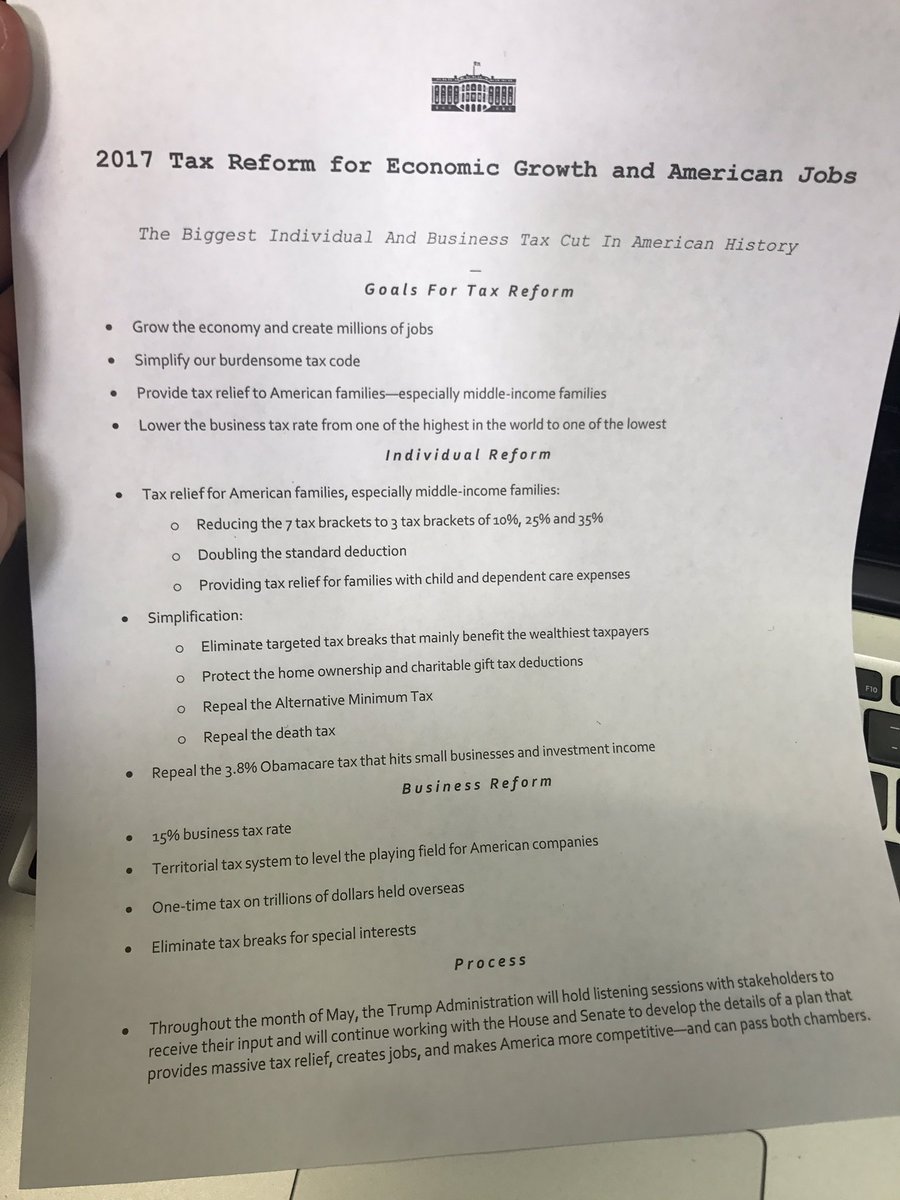
My last post on the 500-word scrawling that has amusingly been called Trump's tax "plan" was quite critical of the proposed 15 percent rate for "business" income, which potentially includes any income that one can contrive to have paid to a business entity (including any state-law entity such as an LLC of which you own 100%), rather than directly to oneself as a wage. I noted that, in practice, this is likely to result in an upside-down rate structure in which rich people commonly pay 15% while their employees pay tax at higher rates. And I noted that it in effect penalizes being an employee who gets paid a salary directly, as if this were a crime that needed to be punished or at least discouraged.
But some readers may have asked: What about the capital gains rate? It was 15% for a while, although it's 20% now. Is the proposed 15% business rate worse than that?
The answer is very clearly Yes. Now, there are some cases in which the 15% capital gains rate works exactly the same way as the "business rate" would - allowing high-earnerrs who have flexibility over cash flow, are well-advised, etc., to get the same result as above. Hedge fund managers can often do this, and it underlies the "carried interest" controversy.
But it's harder to do the capital gains trick than it would be to take advantage of the small business loophole. So less people are able to do it. Plus, there's a whole lot of other stuff mixed in to the capital gains category that has a case for more favorable treatment,
Depending on the particular facts, complicating issues may include the following:
--Capital gain on selling corporate stock gives rise to double taxation if the income is taxed at the corporate level - sometimes a big if.
--There may be nominal inflationary gain mixed in.
--To the extent that capital gain merely reflects earning the normal rate of return on capital, there are arguments for taxing it at a lower rate than that which is economically labor income or rents.
--The capital gains tax is to some extent, and in many cases, a voluntary tax. Hence, the Laffer curve can actually kick in at politically conceivable tax rate levels (e.g., by the time the rate gets into the 30s). This problem is greatly exacerbated by the tax-free step-up in basis for appreciated assets at death, which means the tax can be permanently avoided, rather than merely being deferred. That rule ought to be fixed, but as long as it isn't it constrains how high the capital gains rate should be.
This is not necessarily to defend a 15% or even 20% capital gains rate, especially if we have options at hand beyond just raising the rate, designed (for example) to reduce the feasibility of shoving labor income into the capital gains basket.
But at least we are in the realm of complicated issues and policy tradeoffs - which is not the case with respect to a general 15% "business rate."
It's true that, if we enact a significantly lower corporate rate, it's important to think about the corporate versus non-corporate business tax rate relationship. But (a) the corporate tax is to a degree, albeit imperfectly, more about globally mobile capital than the "business tax," (b) the response should focus on limiting use of the corporation as a tax shelter to escape individual rates on labor income and rents - not extending this problem even further, and (c) corporate income still potentially faces shareholder-level taxation, via the taxation of capital gain and dividends.
Great example of how the "business rate" works: Kansas has idiotically, and to its great detriment, enacted a version of what Trump now wants to do. The Kansas rules actually exempt so-called business income, since state rates are much lower than federal to begin with.
In response, Bill Self, the coach of the Kansas University basketball team, who gets paid $3 million per year, restructured a bit so that 90% of his salary would be "business income' that was exempt from the Kansas income tax. Gruesome details here.
Enacting the 15% business rate, especially in light of Trump's personal stake in the matter (so far as we can understand it despite the lack of transparency), and in light of the Kansas experience, would be straight-out looting and fiscal sabotage, not a policy move that is reasonably debatable or defensible.
Wednesday, April 26, 2017
Preliminary thoughts on the Trump Administration's tax "plan" - what's the rationale for an "employee surtax"?
Perhaps the Trump tax proposal shouldn't be taken too seriously, as it's apparently being rushed out to meet the self-imposed "100 days" deadline and may face mixed prospects at best on the Hill. But when an administration actually claims it wants to do something, it can't just be laughed at as non-serious, even if the proposal is in fact a joke substantively. After all, they're showing us who they are. And what's more, who knows what might end up happening?
That said, suppose the Trump plan includes a 15% rate for corporations and "small business," defined as all passthroughs as well as proprietorships - i.e., non-employee business and labor income generally. And suppose there are neither serious revenue offsets nor significant efforts to limit tax planning that takes advantage of the disparity between the twin 15% rates and the higher (up to 33%?) rates that would still apply to individuals.
Point 1, this seems likely to be such a huge revenue loser that the growth effects might be negative, given fiscal drag from the extra deficits and debt.
Point 2, the Trump tax plan brings to mind the gabelle - the infamous French salt tax, from before the French Revolution, from which nobles were exempt. Given the degree of correlation between income levels and likely ability to take advantage of the 15% passthrough/small business/non-employee rate, it would frequently apply higher marginal rates to people at modest income levels than to those at high income levels.
Think of a law firm in which the partners pay tax at a 15% rate, while the associates, paralegals, and secretaries pay at higher rates (up to 35%). Or think of a high-priced surgeon who pays tax at a 15% rate, while the secretary who answers his phone might pay tax at a higher rate.
The reason I analogize it to the gabelle, rather than just saying the rate structure is upside down, is because one could conceptualize it as being equivalent to having a generally applicable 15% rate, plus (once the marginal rate for employment income gets above that level) a special surtax or penalty tax that applies only to employees, and thus effectively fines or punishes people for having this status. The self-employed, like pre-revolutionary France's nobles when they used salt, are exempt from the employee surtax.
True, entitlement to the lower rate is not perfectly reverse income-correlated. Uber drivers would presumably get the 15% rate. And high-paid CEOs, to the extent they were getting cash salary, would presumably reach the 33% marginal rate. But the "employee surtax" of up to 20% is one from which proportionately more "nobles" than "commoners" would be exempt.
Depending on how the plan defines non-employee income, I suppose it's possible that law professors could start claiming the 15% rate as to their Schedule C income, such as from consulting. So there's that.
Point 3. Why have an employee surtax? This is not only regressive, but inefficient. It interferes with people's making normal business arrangements on a pretax basis. It creates a large tax penalty for employment, as opposed to other ways of earning labor income. Apart from the pure tax planning aspects of trying to avoid employment status, it could shift actual business arrangements in wasteful directions. Indeed, if employment status is tax-penalized enough, I wonder if the incidence could start to shift a bit. This is the scenario in which employee wages have to rise, pre-tax, in order to make up for the tax penalty. It's municipal bonds in reverse - they generally offer less pre-tax than, say, corporate bonds because the income is exempt. In this scenario, employees would be getting more pre-tax than the self-employed / independent contractors because they were in effect subject to a special "employee surtax."
Tuesday, April 25, 2017
NYU Tax Policy Colloquium, week 13: Joel Slemrod (et al), "Taxing Hidden Wealth"
Yesterday our colloquium speaker was Joel Slemrod, presenting "Taxing Hidden Wealth: The Consequences of U.S. Enforcement Initatives on Evasive Foreign Accounts."
The paper uses IRS data to examine what happened after (and presumably in consequence of) a number of steps being taken to address U.S. individual income tax evasion via the hiding of income in foreign accounts. The relevant changes during the period being studied included (1) persuading a number of tax havens to accept information exchange agreements, (2) ending Swiss bank secrecy in the aftermath of the UBS scandal, (3) increasing penalties and enforcement with respect to non-filing of legally mandated FBAR foreign financial asset and bank account disclosures, (4) enacting and implementing FATCA, and (5) offering voluntary disclosure programs under which individuals who had failed to report foreign income could step forward and avoid criminal penalties (although they would have to pay several years' back taxes plus interest and 20% to 27.5% penalties).
One cannot in the abstract predict how effective such measures will be. For example, they might simply induce people to do a better job of hiding their foreign accounts. But the paper finds that compliant responses were quite large, leading to significant increases in tax revenue and reported foreign source interest, dividends, and capital gains. So the set of initiatives appears to have been quite successful, coming closer to what an optimist than a pessimist might have expected up front.
The paper also finds that there were significant "quiet disclosures." That is, people suddenly started filing FBAR reports and including lots of foreign interest and dividend income on their tax returns, as if all this had suddenly arisen in Year 1 of such reporting and inclusion. It's a fair inference that this commonly involved switching from evasion to compliance without participating in the voluntary disclosure programs. This had the advantage of permitting the quiet disclosers to avoid paying back taxes et al, at the cost of leaving them potentially subject to an audit that could include a criminal tax fraud investigation. The IRS warned people that quiet disclosure was a bad idea given this potential blowback, but in practice appears not, at least so far, to have followed up significantly on the threat.
The size and clarity of the empirical results promise this paper major (and well-deserved) attention. For example, if FATCA repeal starts being discussed, there's strong evidence here that the full panoply of what has been done (including but not limited FATCA) has worked very well.
Also of interest is the size of the offshore accounts that were newly reported by U.S. taxpayers in the aftermath of the suite of new policies. The paper estimates that more than 90% of the newly reported foreign asset values came from accounts worth more than $1 million or more. So these were not small fish by most lights.
Two things that one would like to know more about, and that further work by the authors might be able to help illuminate, are:
(1) How rich are these million-dollar account-holders? Contrast the case of (a) a super-rich individual who shoves a million-plus into foreign accounts, while holding other wealth more transparently, from that of (b) someone whose business, after several decades, sells for a million-dollar profit that gets stashed in a foreign account. So here it's the big enchilada in this individual's portfolio, and he or she, while evidently successful, is not super-rich. One reason that this is of interest is that, insofar as (a) is a common answer, it would tend to undermine the standard assumption that the super-rich mainly just avoid taxes, rather than evade them.
(2) Insofar as foreign accounts were being used to evade U.S. taxes, was it mainly about the principal, or just the interest? If principal, then the full amount deposited in the accounts should have been taxed (whether as capital gain, such as from selling a business, or ordinary income, such as contractor fees) but wasn't. But less was at stake (albeit, still raising an important enforcement issue) if people were just hiding the interest and dividends, etc., that they earned on previously earned after-tax income.
People who took advantage of the voluntary disclosure programs got a really good deal insofar as they were able to hide the principal and wait until enough years have passed so the lookback wouldn't find it.
Subscribe to:
Posts (Atom)